
Mercedes-Benz M260 & M264 Cylinder Head Problems in Surrey BC: Affected Models, Symptoms and What the Repair Really Involves
11/16/2026
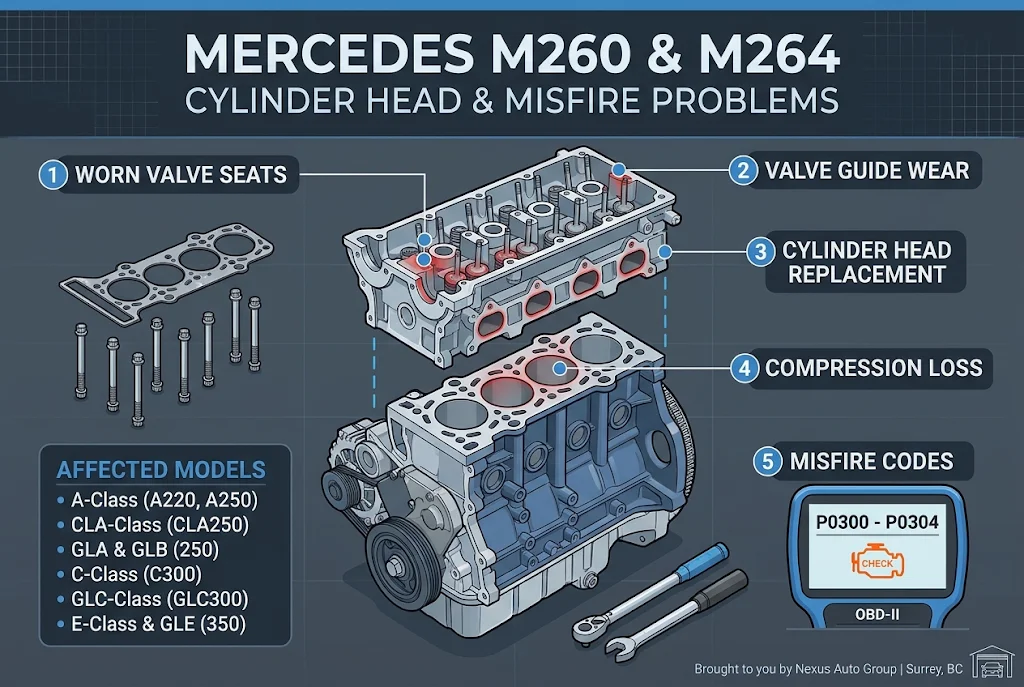
If your Mercedes-Benz with a 2.0L turbo engine has started to run rough, shake at idle, or flash a misfire warning, you may have been told it's the spark plugs, ignition coils, or fuel injectors. Sometimes it is. But on certain late-model Mercedes-Benz vehicles, those parts get replaced, the misfire stays, and the real culprit turns out to be the cylinder head itself.
The M260 and M264 engines have a well-documented cylinder head issue, and Mercedes-Benz has acknowledged it through technical service bulletins. In this guide we explain what goes wrong, which vehicles are affected, how it's diagnosed, and what the repair involves.
What Are the M260 and M264 Engines?
The M260 and M264 are closely related 2.0L turbocharged four-cylinder engines that power a large part of Mercedes-Benz's current lineup:
- M260: the transverse-mounted version, used in the front-wheel-drive-based compact cars.
- M264: the longitudinally mounted version, used in the rear-wheel-drive-based sedans and SUVs, and available with a 48-volt mild-hybrid system.
They share the same basic architecture, and the same cylinder head problem has been reported on both.
What Goes Wrong: Worn Valve Seats and Guides
The problem is in the cylinder head. Reports and technical bulletins describe premature wear of the valve seats and, in some descriptions, the exhaust valve guides. When the valve can no longer seal properly against its seat, combustion pressure leaks past it. That means the cylinder loses compression, which causes misfires, rough running, and reduced power.
According to a Mercedes-Benz service bulletin covering M260 and M264 engines (TSB LI01.30-P-072328), the cause is a leaking valve seat in the cylinder head. The bulletin's repair instruction is to replace the complete cylinder head if valve seat damage is found, because the valve seats cannot be reworked.
If it's left alone, the misfire can send unburned fuel into the exhaust, stress the catalytic converter, and in more advanced cases lead to further engine damage, including piston damage.
Which Mercedes-Benz Models Are Affected?
Mercedes-Benz has applied the M260 and M264 across many models. The following vehicles are commonly reported with these engines, generally in model years from about 2019 onward:
M260 (compact, transverse engine):
- A-Class (A220, A250)
- CLA-Class (CLA250)
- GLA-Class (GLA250)
- GLB-Class (GLB250)
- Related AMG 35 versions use a closely related engine and are worth checking
M264 (longitudinal engine):
- C-Class (C300)
- GLC-Class (GLC300)
- E-Class (E350 and other 2.0L variants)
- GLE-Class (GLE350)
- Some Sprinter vans have also been reported with this engine family
Exact year ranges, trims, and engine variants differ by market and model, and not every vehicle with these engines will develop the problem. If you're unsure whether your vehicle has an M260 or M264, give us your VIN and we can confirm. We can also tell you whether any manufacturer bulletins or warranty extensions apply to your specific vehicle.
Symptoms of the M260 / M264 Cylinder Head Issue
Watch for these warning signs:
- Misfire codes such as P0300 (random misfire) or cylinder-specific codes P0301, P0302, P0303, and P0304
- Rough idle and engine shaking, especially at idle or when cold
- Check engine light, possibly flashing under load
- Loss of power or hesitation, sometimes suddenly, such as when merging onto a highway
- Poor shifting or jerking when accelerating, since the transmission feels the misfire
- Fault codes related to mixture formation or injector quantity adjustment, which can appear when the engine compensates for a leaking cylinder
- Misfires that return after replacing spark plugs, coils, or injectors
Some owners report symptoms at surprisingly low mileage, which is part of why the problem has attracted so much attention.
Why It's Often Misdiagnosed
This is where many owners lose time and money. A leaking valve seat produces the same fault codes and symptoms as a bad ignition coil, worn spark plug, failing fuel injector, or even a faulty engine control module. It's common to see a car that has had plugs, coils, and injectors replaced, and still misfires.
The reliable way to confirm a cylinder head problem is mechanical testing, not guessing:
- Scan and review live data to identify which cylinder is misfiring and how the engine is compensating.
- Perform a cylinder leakage (leak-down) test and compression test to measure how well each cylinder holds pressure.
- Determine where the leak is, whether intake or exhaust valve, which indicates a valve seat issue and not an ignition or fuel problem.
- Rule out other causes such as ignition, injector, or boost-leak problems first. A leaking intercooler or boost hose can also cause rough running, so a proper diagnosis matters.
Our diagnostics and OBD codes resources explain how we approach this, and our guide to what your check engine light really means is a good starting point if a warning light brought you here.
The Extent of the Repair: What Cylinder Head Replacement Involves
We want you to understand this clearly up front, because it's a major repair, not a quick fix.
When valve seat or valve guide wear is confirmed, the correct repair is replacement of the complete cylinder head with an updated part. This is not a job where the head can be lightly repaired in place. A typical repair involves:
- Diagnosis and confirmation, with leak-down and compression testing so we know a head replacement is truly what's needed.
- De-energizing the vehicle properly, including following high-voltage safety procedures on models with the 48-volt mild-hybrid system.
- Draining coolant and oil, and removing the intake system, turbocharger connections, exhaust components, wiring, fuel lines, and ancillaries needed to reach the head.
- Removing the valve cover, camshafts, and valve train, marking and keeping components in order so they go back where they came from.
- Removing the timing components and releasing the cylinder head from the block.
- Removing the old cylinder head and cleaning the block surface thoroughly so the new head seals properly.
- Installing the new cylinder head with a new head gasket, new head bolts, and new seals, as required by Mercedes-Benz procedures, using proper torque specifications.
- Reinstalling the camshafts, timing components, and valve train and setting engine timing correctly with the right tools.
- Reassembling the engine, refilling and bleeding the cooling system, and replacing the engine oil and filter. Mercedes-Benz specifically calls for fresh oil and a new filter after the repair.
- Final scan, adaptations, test drive, and re-check to confirm the misfire is gone and the engine is running smoothly.
This is a labour-intensive job that takes multiple days in the shop, not hours. Parts availability can also affect the timeline, since the updated cylinder head and related parts are sourced for your specific engine.
Why Choose Nexus Auto Group for M260 and M264 Cylinder Head Work
- Mercedes-Benz experience. We work on Mercedes-Benz vehicles every day, and understand the platform and the way these engines are assembled.
- Diagnosis first. We confirm the cause with proper testing before recommending a major repair, so you aren't paying for parts you don't need.
- Proper procedures and tools. Timing, torque specs, and new hardware are handled correctly, because there's no room for shortcuts on a repair this size.
- Clear communication. We explain the findings, the repair scope, and the expected timeline before work begins.
Warranty, Bulletins and Extended Coverage
Because Mercedes-Benz has recognized this issue, it's worth checking whether your vehicle qualifies for assistance before you pay for a repair:
- Manufacturer coverage. Mercedes-Benz has issued technical bulletins on these engines, and in some markets has offered extended warranty coverage on affected M260 engines. Coverage depends on your model, model year, VIN, and market, so confirm with a Mercedes-Benz dealer. We can help you work out what to ask.
- Extended warranty plans. If you have a third-party plan, engine internal repairs may be covered depending on your terms. We're an approved repair facility for both Global Warranty and Lubrico Warranty, and on covered warranty repairs that run longer than two days because of parts availability, we provide a courtesy vehicle.
Competitive Prices and Honest Quotes
A cylinder head replacement is a significant repair, and you deserve a clear picture of what's involved. Nexus Auto Group offers competitive pricing and a detailed quote before work begins, with an honest explanation of the diagnosis and the work required. If your misfire turns out to be something simpler, like an ignition or boost-leak issue, we'll tell you.
Mercedes-Benz Engine Repair in Surrey, BC
For more on our services, see our Mercedes-Benz repair service, engine repairs, and check engine light service pages, and our European car maintenance schedule guide to help keep your engine healthy. If you're buying a used M260 or M264 Mercedes, a vehicle inspection that includes a cylinder leakage check is well worth it.
If your Mercedes-Benz is misfiring, running rough, or showing a check engine light, don't keep driving it and hope. Bring it in for a proper diagnosis.
Book your Mercedes-Benz diagnosis today: Call Nexus Auto Group at 604-396-3242, send us a message, or visit us at 12521 King George Blvd, Surrey, BC (get directions).
Related Reading & Services
Contact Information
Address:12521 King George Blvd, Surrey BC V3V 3K3