
BMW Oil Leaks in Surrey BC: Common Leaks on N20, N52, N54, N55 and Other BMW Engines and Why You Shouldn't Ignore Them
11/13/2026
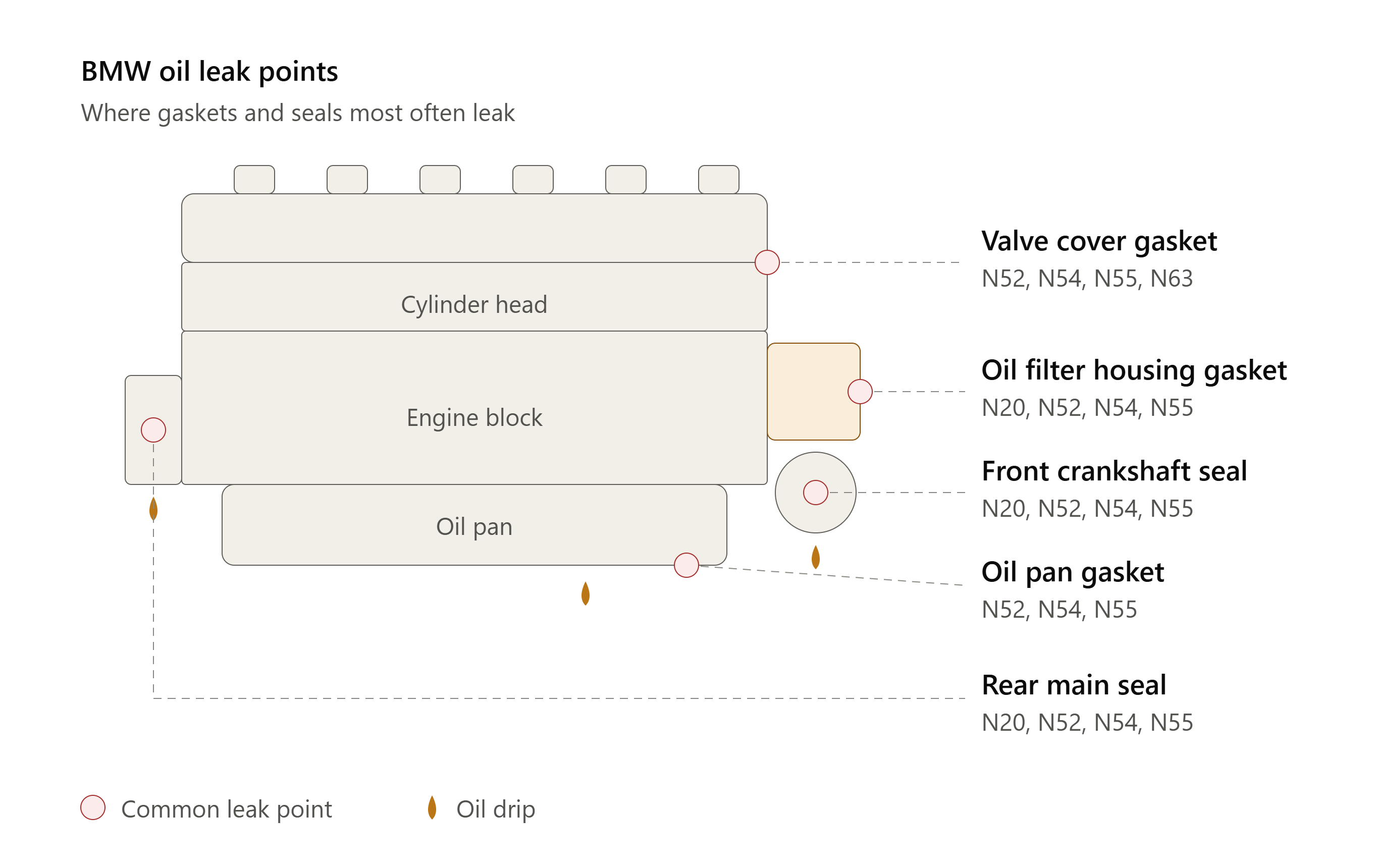
If you own a BMW, there's a good chance you've seen a drip on the driveway, smelled burning oil after a drive, or had a service advisor mention a "slight oil seepage." It's one of the most common conversations we have with BMW owners in Surrey, and it's easy to brush off. But oil leaks rarely stay small, and where the oil ends up often matters more than how much is leaking.
In this guide we cover the most common BMW oil leak locations, how they differ across popular engines (N20, N52, N54, N55, and more), what the warning signs are, and why it pays to deal with them early.
Why BMWs Develop Oil Leaks
BMW engines use gaskets, seals, and O-rings made of rubber and composite materials to keep oil where it belongs. Over years of heat cycles, those parts harden, shrink, and crack. Add the high under-hood temperatures of modern turbocharged engines, and it's no surprise that gasket leaks are a well-known maintenance item on BMWs of a certain age. It isn't a sign of a bad owner or a bad engine. It's a sign that rubber parts wear out.
Extended oil change intervals can contribute too. Oil that is left in too long can form sludge, which can build up under valve covers and around seals, and clean, fresh oil helps keep those areas in better shape. Our maintenance schedule guide covers what your BMW actually needs.
The Most Common BMW Oil Leaks
1. Oil filter housing gasket (the "oil stand" gasket)
This is one of the most common oil leaks on BMWs, and on many engines it's the most common one of all. The oil filter housing is bolted to the engine block with a profile gasket between them. Over time the gasket shrinks, hardens, and begins to leak. The same gasket design is used on nearly every BMW four- and six-cylinder engine since about 2006, including the N20, N26, N51, N52, N54, N55, and S55.
It's also one of the messiest leaks, because the oil runs down the front of the engine, and it can end up on the serpentine belt, pulleys, and other components below. Many owners mistake it for an oil pan leak. If your car has a factory oil cooler, the oil cooler thermostat gasket should be replaced at the same time. On N54 and N55 engines, the gaskets between the thermostat plate and the filter housing are another common leak point.
2. Valve cover gasket
The valve cover gasket is another top offender, found on most BMW models and especially common on N52 and N54 engines. Telltale signs include wet or oily areas around the valve cover bolts, oil at the front of the engine, or seepage along the joint between the valve cover and the cylinder head. When the gasket leaks, oil can also work its way into the spark plug wells, which can lead to misfires, ignition coil damage, and a rough-running engine.
On N52 engines, the valve cover job is often done together with related seals, such as the Valvetronic gasket and eccentric shaft sensor seal, because they're accessed during the same repair.
3. Oil pan gasket
The oil pan gasket seals the oil pan to the engine block. It's a very common leak area on the N52, N54, and N55, and on many other BMW engines as the car ages. A leaking pan gasket typically shows up as oil on the underside of the engine or drips onto the ground. Because the oil filter housing leak can run down the block and mimic a pan leak, proper diagnosis is important before parts are replaced.
4. Oil cooler lines and oil cooler housing gaskets
On BMWs with oil coolers, the hoses, lines, and housing gaskets can leak as the rubber ages. These leaks tend to drip onto lower engine components, and they're often addressed together with the oil filter housing gasket because the parts are in the same area.
5. Crankshaft seals (front and rear main seals)
The crankshaft seals sit at each end of the crankshaft. A front seal leak tends to show up at the front of the engine, while a rear main seal leak appears between the engine and transmission. Rear seal replacement is a bigger job because the transmission has to be removed to reach it. These seals are common on the N20, N52, N54, and N55, among others.
6. Camshaft, VANOS, and sensor seals
Smaller seals and O-rings at the camshaft sensors, VANOS solenoids, and eccentric shaft sensor can weep oil, and on N52 engines in particular, oil inside or around a sensor is a reason to replace it during other work.
Leaks by Engine: What We See Most Often
- N20 (2.0L turbo four-cylinder): oil filter housing gasket, valve cover gasket, oil pan gasket, and crankshaft seals. The N20 is also known for timing chain wear, so a leak and a rattle together deserve a close look.
- N52 (naturally aspirated 3.0L inline-six): valve cover gasket is the most frequent leak, followed by the oil filter housing gasket, Valvetronic seal, camshaft seals, and eccentric shaft sensor seal. Oil pan gasket leaks are also seen.
- N54 (twin-turbo 3.0L inline-six): valve cover gasket, oil filter housing gasket, thermostat plate-to-housing gaskets, and oil pan gasket.
- N55 (single-turbo 3.0L inline-six): oil filter housing gasket, valve cover gasket, oil pan gasket, thermostat plate-to-housing gaskets, and crankshaft seals. Sludge under the valve cover has been seen on engines serviced at long intervals.
- N63 / S63 (4.4L twin-turbo V8): valve cover gaskets and other oil leaks, which tend to be more labour-intensive because of the V8 layout and tight packaging.
- S54 / S55 (M engines): valve cover gaskets and the same oil filter housing gasket design on the S55.
- B48 / B58 (newer four- and six-cylinder engines): generally better sealed from the factory, but gaskets and seals still age, and leaks do appear as these cars get older.
Every car is different, and the exact leak depends on age, mileage, and how the car has been maintained. That's why we diagnose first instead of guessing.
Signs Your BMW Has an Oil Leak
- Oil spots or drips under the car where you park
- Burning oil smell after driving, especially when the engine is hot, because oil is dripping onto hot exhaust or engine components
- Visible oil around the valve cover, front of the engine, or the lower part of the engine
- Oil on the serpentine belt or pulleys, which can cause belt slippage and noise
- Low oil level warnings or frequently needing to top up oil
- Smoke from the engine bay
- Misfires or a rough idle, which can happen if oil gets into the spark plug wells
- A check engine light if a leak affects a sensor or causes a misfire
Why Oil Leaks Matter
It's tempting to treat a small leak as a nuisance. Here's why it's worth taking seriously:
- Engine damage from low oil. Oil is what keeps the engine's moving parts from wearing out. A leak that gets worse can leave the engine low on oil, and that can cause serious and very expensive damage, particularly if the oil warning isn't noticed in time.
- Oil on belts and rubber parts. Oil can attack serpentine belts, hoses, engine mounts, and wiring, causing them to degrade, slip, or fail early, and a belt failure can mean a breakdown and further damage.
- Fire risk. Oil dripping onto a hot exhaust manifold or turbocharger can smoke and, in worse cases, ignite.
- Ignition problems. Oil in spark plug wells can damage ignition coils and cause misfires.
- Bigger repair bills. A gasket caught early is a relatively simple repair. Left alone, the leak can spread, damage other components, and turn a small job into a larger one.
- Resale value and inspections. A leaking engine is a red flag for buyers and during pre-purchase inspections.
- Environmental impact. Oil on the road eventually washes into storm drains.
How We Diagnose and Repair BMW Oil Leaks
Finding the true source of an oil leak is half the battle, because oil travels. A leak at the top of the engine can show up at the bottom. Our approach is:
- Inspection and leak tracing. We lift the car and inspect from above and below, and where needed clean the area so we can find the true source rather than guess. Our diagnostics and vehicle inspections help identify related issues.
- Check for related faults. We scan for stored codes and look at sensors and components the oil may have affected, such as ignition coils and belts. Our OBD codes page explains what the codes mean.
- Repair the source. We replace the failed gasket, seal, or line using quality parts.
- Replace related parts together. Because many gaskets sit behind belts, tensioners, and other components, it often makes sense to replace parts that are already accessible, which saves you paying for the same labour twice.
- Clean up and verify. We clean the affected area, top off the oil, and road test the car to confirm the leak is fixed.
Competitive Prices and Honest Quotes
Oil leak repair costs vary a lot depending on the engine and the leak, from simpler gasket jobs to more involved work like a rear main seal. Nexus Auto Group offers competitive pricing and a clear quote before work begins, with an honest explanation of what's leaking, how urgent it is, and which repairs make sense to combine.
If your BMW is covered by an extended warranty, note that coverage for gaskets and seals varies a lot by plan, since many treat them as wear items. We're an approved repair facility for both Global Warranty and Lubrico Warranty, so check your policy and call us before work begins.
BMW Oil Leak Repair in Surrey, BC
Nexus Auto Group specializes in European vehicles, and BMW is one of our core brands. See our BMW repair service and engine repair pages for more, and if a warning light brought you here, our guide to what your check engine light really means is a good place to start.
If you've noticed drips, a burning smell, or oil where it shouldn't be, don't wait for it to get worse. Bring it in for an inspection.
Book your BMW oil leak inspection today: Call Nexus Auto Group at 604-396-3242, send us a message, or visit us at 12521 King George Blvd, Surrey, BC (get directions).
Related Reading & Services
Contact Information
Address:12521 King George Blvd, Surrey BC V3V 3K3